
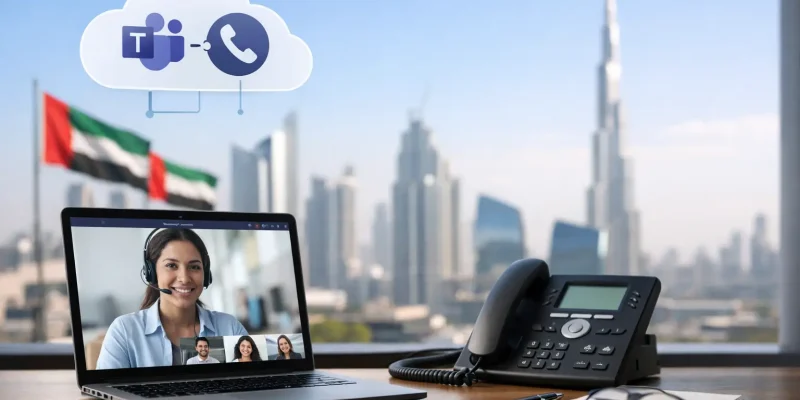
A Teams meeting can begin anywhere, but a business call still has to reach customers, suppliers, and emergency services through the local telephone network. That is where Microsoft Teams Direct Routing UAE becomes an operational decision, not simply a Microsoft licensing choice. It connects Microsoft Teams to UAE PSTN services through a certified Session Border Controller (SBC), allowing employees to make and receive external calls from the same Teams environment they already use for chat, meetings, and collaboration.
For organizations replacing an aging PBX, supporting hybrid staff, or consolidating communications across UAE and GCC locations, Direct Routing can reduce the number of platforms IT teams need to operate. The value, however, depends on the quality of the telecom connection, SBC design, security controls, and local implementation support behind it.
What Microsoft Teams Direct Routing UAE Actually Does
Microsoft Teams provides the user interface for calls, voicemail, presence, meetings, and collaboration. Direct Routing provides the connection between Teams and the public switched telephone network (PSTN). Rather than relying on a separate desk-phone system for external calling, users can place and answer business calls within Teams on their desktop, mobile device, or approved IP phone.
The SBC is the critical component in this architecture. It sits between Microsoft Teams and the telecom network, managing SIP signaling, media routing, interoperability, encryption, and policy enforcement. In a UAE deployment, it can also support connectivity arrangements with local providers such as e& and du, subject to the organization’s service eligibility and regulatory requirements.
This model gives businesses more design flexibility than a standard cloud calling package. A company may retain existing telephone numbers, deploy new number ranges, connect branch locations, and apply routing rules based on department, geography, business hours, or business continuity needs. It can also integrate Teams calling with existing PBX, contact center, CRM, and analog-device environments where a full replacement is not practical on day one.
Why Local PSTN Connectivity Matters
Calling is only as dependable as the path between Teams and the local carrier network. UAE organizations should not treat PSTN connectivity as an afterthought, especially where customer service, sales operations, healthcare coordination, logistics, or emergency escalation depends on phones being available.
Local telecom connectivity helps ensure that number provisioning, caller ID presentation, call routing, and support processes are designed around UAE operating conditions. It also makes it easier to coordinate when an issue crosses several layers: the Microsoft tenant, the SBC, the internet connection, local carrier service, and the user device.
TDRA requirements, carrier policies, and number-management processes can affect what is possible in a given deployment. For example, a business may need to evaluate whether it can port existing numbers, how outbound caller IDs will be handled, and which service locations require dedicated routing. These are design questions to resolve before migration, not after users have moved to a new calling platform.
A locally experienced integrator brings value by translating those requirements into a workable architecture. Cloud Move combines Teams Voice Direct Routing design with UAE telecom connectivity, compliance awareness, SBC configuration, and lifecycle support, so internal IT teams are not left coordinating multiple vendors during an outage.
Where Direct Routing Fits Best
Direct Routing is particularly useful when Teams is already the organization’s primary collaboration platform but voice remains fragmented across PBXs, mobile phones, or branch-specific carrier services. It gives users one familiar workspace while allowing the business to maintain greater control over telephony design.
A Dubai headquarters with branches in Abu Dhabi, Sharjah, Riyadh, or other GCC locations may use Direct Routing to standardize the employee calling experience while retaining appropriate local telecom services at each site. A growing organization may start with a cloud-based SBC and add users, departments, or locations as demand increases. An enterprise with strict resilience requirements may choose a hybrid model that maintains selected on-premise voice systems alongside Teams during a phased transition.
It is also a practical option for organizations with specialized communications requirements. Reception teams may need shared call queues and attendant handling. Sales departments may need controlled outbound caller IDs. Service desks may need recorded calls, reporting, and escalation paths. Warehouses, hotels, clinics, and facilities teams may still rely on analog devices, intercoms, or SIP endpoints that need careful integration rather than abrupt removal.
Direct Routing is not automatically the right answer for every company. A small organization with simple calling needs may prefer a more standardized option if it meets local availability and feature requirements. Direct Routing is strongest when flexibility, carrier choice, integration, number retention, or advanced routing matter enough to justify a properly engineered solution.
The Architecture Behind Reliable Teams Calling
A dependable deployment starts with more than assigning Teams Phone licenses. It requires an end-to-end assessment of call volumes, sites, network readiness, user groups, existing numbers, and critical call flows.
Session Border Controllers and Security
The SBC protects and manages the voice boundary between Microsoft Teams and external SIP networks. It supports encrypted signaling and media, normalizes communications between different systems, and provides policy controls that help prevent unauthorized call activity.
SBC placement matters. Cloud-hosted SBCs can offer speed and scalability for distributed organizations. On-premise SBCs may suit environments with specific network, security, or legacy-integration requirements. Some businesses use a hybrid approach to balance local survivability with centralized management.
Security should also include identity controls, role-based administration, call permissions, fraud monitoring, logging, and clear change-management processes. A voice platform is part of the organization’s operational infrastructure. Treating it as a simple software add-on can expose the business to avoidable risk.
Network Readiness and Call Quality
Teams call quality depends on the network path, not just internet bandwidth. Voice traffic is sensitive to latency, jitter, packet loss, Wi-Fi coverage, VPN routing, and firewall configuration. A network may appear healthy for email and web applications while still delivering poor audio during busy periods.
Before rollout, IT teams should assess WAN capacity, internet breakout points, quality-of-service policies, wireless performance, and how remote users connect. This is especially important for contact center agents, executive users, and teams handling high call volumes. Call-quality monitoring should continue after go-live, because growth, new sites, and network changes can alter performance.
Business Continuity by Design
No communications design can promise that every service component will never fail. The goal is to reduce the impact of failures and provide clear recovery paths. That may include redundant SBC capacity, alternative carrier routing, multiple internet links, backup power, failover destinations, and defined procedures for service incidents.
The right level of resilience depends on the cost of downtime. A small back-office team may accept a simpler model. A 24/7 contact center, financial operation, or healthcare service may require stronger redundancy, active monitoring, and tested failover plans. The architecture should reflect the real business consequence of missed calls.
A Practical Migration Approach
The safest Teams voice migrations are phased and measurable. Start by documenting the current environment: telephone numbers, extensions, call queues, auto attendants, hunt groups, devices, integrations, carrier contracts, and peak calling patterns. This often identifies dependencies that are not visible in a basic phone inventory.
Next, define the target call flows. Decide which users need direct dialing, which departments need queues, what happens outside business hours, where calls should go during an outage, and how reception or contact center teams will work. A good design is easy for users to follow and straightforward for IT teams to support.
A pilot group should include a mix of typical users and demanding use cases, such as executives, reception staff, remote employees, and high-volume callers. Test inbound and outbound calls, caller ID, transfers, voicemail, mobile usage, emergency processes, and failover behavior. User feedback during the pilot is valuable because small workflow gaps can become major adoption issues at scale.
Once the pilot is stable, migrate in controlled groups. Communicate changes clearly, provide short user guidance, and ensure that support teams have escalation contacts and access to the right monitoring tools. Number porting and carrier coordination should be scheduled carefully to minimize disruption.
Questions to Ask Before Choosing a Provider
A Direct Routing provider should be able to explain the design in clear operational terms, without unnecessary complexity. Ask how PSTN connectivity will be delivered in the UAE, where SBC services will be hosted, how encryption and access controls are managed, and what happens if a primary route or internet link fails.
Also ask who owns incident coordination. When a call-quality issue involves Microsoft Teams, the SBC, the carrier, and the customer network, businesses need a partner that can investigate across the full chain instead of redirecting every issue to another vendor. Confirm support hours, escalation procedures, monitoring capabilities, and the process for adding users, sites, numbers, or new call flows.
Cost should be evaluated beyond the initial implementation. Compare recurring PSTN charges, SBC services, Microsoft licensing, support coverage, migration effort, and the cost of maintaining legacy systems. The least expensive monthly option can become costly if it creates fragmented support, poor visibility, or repeated downtime.
The best starting point is a focused assessment of your current calling environment and the business processes that rely on it. With the right UAE connectivity, SBC design, and support model, Teams can become a dependable business phone system that grows without forcing your operations to work around the technology.
3 Comments on “Microsoft Teams Direct Routing UAE Explained”
XCALLY Contact Center Solution for UAE Teams - Cloud Move
7 Sep 2026[…] sized Session Border Controller can still affect every interaction. For UAE deployments, direct PSTN connectivity and coordination with local telecom providers such as e& and du should be planned from the […]
Hybrid PBX for Multi-Site Offices That Works - Cloud Move
11 Sep 2026[…] between platforms, and help enforce call-routing and security policies. In environments using Microsoft Teams Phone with Direct Routing, Zoom Phone BYOC, or a cloud PBX, the SBC is often the technical point where enterprise […]
Business PSTN Connectivity UAE Deployment - Cloud Move
12 Sep 2026[…] deployment model depends on the communications platform. Microsoft Teams Voice Direct Routing, for example, can connect Teams users to local PSTN services through certified SBC architecture. […]