
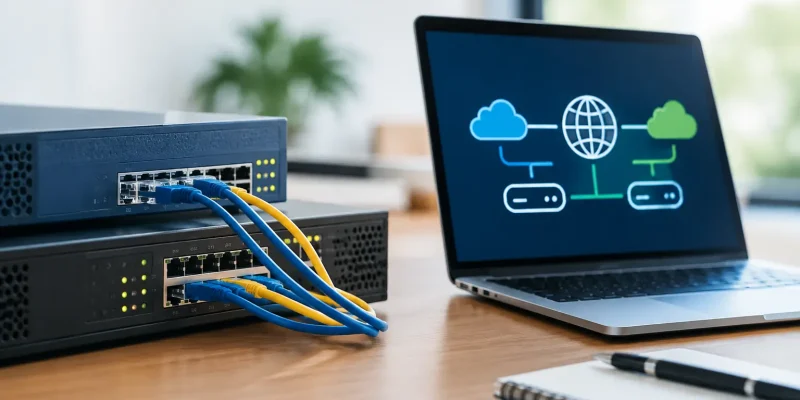
A branch can keep its local network running while the business is effectively offline. If the primary internet circuit fails, cloud applications may stop responding, Teams calls can drop, contact center agents can lose their queues, and SIP trunks may become unreachable. To configure redundant WAN failover correctly, treat it as a business continuity design exercise, not simply a second internet connection.
For organizations running multiple sites, cloud PBX, Microsoft Teams Direct Routing, Zoom Phone BYOC, or omnichannel contact centers, WAN availability is part of the customer experience. The right design keeps priority services operating when a carrier circuit, edge device, DNS service, or upstream route fails. It also avoids the equally damaging problem of unstable links constantly switching back and forth.
Start with the services that cannot stop
Before selecting circuits or configuring an SD-WAN appliance, identify what each location must continue doing during an outage. A headquarters, retail branch, warehouse, contact center, and remote office will not have the same requirements.
For example, a contact center may need voice signaling, media traffic, CRM access, payment tools, and supervisor reporting to remain available. A branch may prioritize card terminals, cloud applications, and inbound customer calls. A smaller site may accept reduced performance during failover, provided core voice and secure access remain available.
This assessment determines the required backup capacity. A common mistake is purchasing a low-bandwidth backup circuit that can technically carry a few calls but cannot support the number of agents, applications, and VPN users expected to work through an outage. Size the secondary link for the critical workload, not for a network test conducted after hours.
Document dependencies as well. A cloud calling platform can be available while a local Session Border Controller, firewall, DNS resolver, identity provider, or VPN tunnel creates a single point of failure. Redundancy must cover the complete service path.
Choose diverse WAN paths, not just two contracts
Two circuits from the same provider may improve availability, but they are not automatically diverse. They can share building entry points, last-mile infrastructure, a local exchange, or an upstream transport route. A single construction issue or carrier fault can still affect both links.
Where possible, use different carriers and different access technologies. A business fiber circuit paired with a separate fiber provider, fixed wireless, or enterprise-grade 5G connection can reduce shared risk. In UAE and GCC deployments, the availability and design options depend on the site, building infrastructure, and approved telecom connectivity arrangements. A site survey and carrier-path review are worthwhile before committing to a design.
Physical diversity matters inside the premises too. If both circuits terminate in the same unprotected cabinet, connect through one power supply, or rely on one firewall, the architecture still has a critical failure point. Separate power feeds, UPS coverage, device redundancy, and clearly labeled handoff paths make failover more meaningful.
Configure redundant WAN failover around application health
Basic failover commonly works by sending periodic ping requests to a public IP address. This can detect a complete outage, but it does not prove that the services your teams use are working. A circuit may still reach the internet while DNS fails, packet loss rises, SIP traffic is impaired, or a required cloud platform becomes inaccessible.
A better approach combines several health checks: gateway reachability, DNS resolution, loss and latency thresholds, and probes to relevant cloud endpoints. For voice and video services, jitter and packet loss deserve particular attention. A link with high latency may be acceptable for email but produce poor call quality and one-way audio.
The failover policy should distinguish between a hard failure and degraded performance. A hard failure can trigger an immediate move to the secondary link. For degradation, use thresholds and sustained measurement periods so brief congestion does not cause unnecessary switching. This is where hysteresis and hold-down timers matter: they prevent route flapping when a primary circuit recovers intermittently.
Failback requires the same discipline. Automatically returning traffic to the primary link as soon as one health check succeeds can interrupt active calls or VPN sessions. Many organizations wait until the primary connection has remained stable for a defined period, then fail back during a controlled window or after active sessions drain naturally.
Active-passive versus active-active design
Active-passive is the simpler model. The primary WAN carries normal traffic, and the standby connection takes over only after a defined failure condition. It is easier to operate, usually keeps routing predictable, and works well when the backup is intended strictly for continuity.
Active-active uses both links under normal conditions. It can increase usable capacity and allow traffic steering by application, path quality, or policy. For example, a network can prefer one path for real-time voice and another for general web traffic. The trade-off is greater complexity. Firewall state, NAT behavior, asymmetric routing, voice media paths, and monitoring must all be designed carefully.
Neither model is universally better. A single-site business with limited IT resources may benefit from a well-tested active-passive configuration. A multi-site organization with heavy cloud and contact center traffic may justify active-active SD-WAN with application-aware routing.
Protect voice, calling, and contact center traffic
Voice traffic exposes weak failover designs quickly. Calls are sensitive to loss, jitter, and changes in network address translation. When the WAN path changes, existing sessions may drop even if new calls establish successfully. Set expectations accordingly: failover can preserve service availability without guaranteeing that every live call survives a carrier outage.
Prioritize SIP signaling, RTP media, Teams media, and approved contact center traffic using quality-of-service policies. On the backup circuit, restrict nonessential traffic such as large software updates, guest Wi-Fi, backups, and streaming. This keeps bandwidth available for customer-facing activity when capacity is constrained.
For Direct Routing and carrier connectivity, review Session Border Controller placement and high availability. A resilient WAN design may need redundant SBC instances, separate public IP paths, or geographically appropriate cloud deployment. Keep NAT rules, certificate requirements, firewall policies, and DNS behavior consistent across both paths. A backup circuit that lacks the necessary security policy is not a usable backup.
If agents work remotely, consider their connectivity separately. Office WAN failover will not resolve a home broadband outage. Remote-work continuity may require guidance on secondary access, supported mobile hotspots, secure client configuration, and fallback call-handling procedures.
Build security into the failover policy
Every WAN path must meet the same security standard. That includes firewall inspection, encrypted tunnels where needed, DNS controls, logging, segmentation, and access policies. It is easy to create an emergency route that bypasses normal inspection or sends internal traffic across a consumer-grade connection without the required protections.
Confirm that VPN tunnels can re-establish through the secondary WAN and that routing avoids overlapping networks. If cloud workloads use IP allowlists, make sure the secondary public IP address is included. For regulated communications environments, review how failover affects call recording, data location, telecom requirements, and audit logs.
Security teams should also know what alerts to expect. A WAN transition is operationally significant, but it should not create hundreds of disconnected alerts that obscure the root cause. Correlate circuit state, interface status, tunnel health, call-quality data, and application performance in one monitoring view where possible.
Test failures deliberately and document the results
A configuration is only dependable after it has been tested under realistic conditions. Schedule controlled tests that disconnect the primary circuit, simulate DNS failure, impair packet quality, restart edge equipment, and verify restoration. Test during an agreed maintenance window, with business owners included for services that affect customers.
During each test, confirm more than internet browsing. Place inbound and outbound calls, check contact center queues, validate CRM access, establish VPN connectivity, review cloud application sessions, and measure call quality after the transition. Record the actual failover time, which sessions were interrupted, which alerts appeared, and whether staff followed the intended process.
Keep a short operational runbook with circuit details, escalation contacts, provider reference numbers, interface labels, expected thresholds, and a fallback procedure if automation does not work. This document is most valuable at 2 a.m. when the person responding did not build the network.
Cloud Move helps organizations design and operate resilient communications environments that connect WAN architecture, cloud calling, SBCs, telecom connectivity, and ongoing support. The practical goal is straightforward: a circuit failure should become an IT event to investigate, not a reason for customers to stop reaching your business.
A second circuit is only the starting point. When failover policy, application priorities, security controls, and testing are designed together, your teams have a clear path to keep serving customers when the primary path disappears.
2 Comments on “How to Configure Redundant WAN Failover Networks”
Cloud Telephony for UAE Businesses That Cannot Pause - Cloud Move
6 Oct 2026[…] For critical locations, redundant internet links, resilient SBC deployment, backup power, and automatic failover routing should be considered. If a branch loses connectivity, can calls reroute to another office, a mobile […]
Contact Center Design That Holds Up Under Pressure - Cloud Move
24 Oct 2026[…] customer experience platform cannot compensate for weak underlying connectivity. Voice quality, call continuity, and system availability depend on the full communications path: […]