
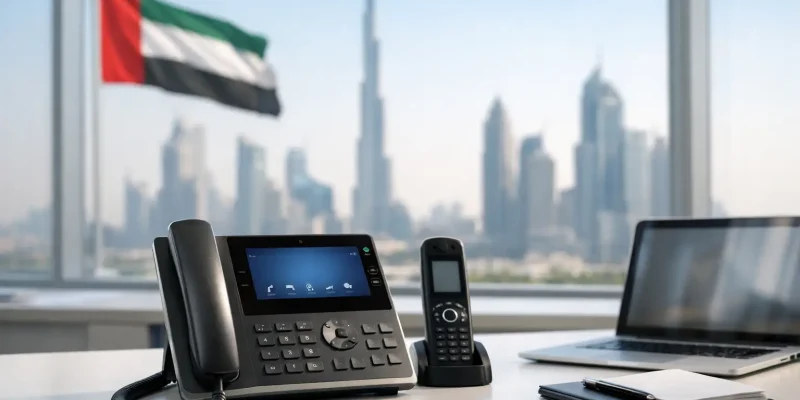
A business phone system can look capable in a product demo and still create a serious operational issue once it needs UAE phone numbers, local calling, or contact center connectivity. A TDRA compliant business phone system is not simply a cloud calling app with an international number attached. It is an architecture designed to connect people, sites, and customer conversations through approved local telecom pathways while maintaining security, reliability, and control.
For UAE organizations, that distinction matters. Voice communications sit at the center of sales, service, operations, and emergency response. If the system is difficult to support, cannot connect correctly to local PSTN services, or falls outside applicable regulatory requirements, the impact reaches far beyond the IT team.
What TDRA Compliance Means for Business Calling
The Telecommunications and Digital Government Regulatory Authority regulates telecommunications services in the UAE. For businesses deploying cloud PBX, Microsoft Teams Phone, Zoom Phone, or a contact center platform, compliance affects how voice services and UAE telephone numbers are delivered, connected, and managed.
In practical terms, a compliant design uses authorized local telecommunications connectivity and the correct technical controls to deliver PSTN calling. This is especially relevant when an organization wants to retain existing UAE numbers, provision new direct inward dialing numbers, operate a multi-site PBX, or support high-volume customer service queues.
A common mistake is treating voice as just another software subscription. Collaboration platforms are valuable, but they do not remove the need for compliant local carrier connectivity. The application layer, calling plans, Session Border Controllers, number management, and telecom connection must work together.
For a company with one office and a small call volume, the design may be relatively straightforward. For a regional organization with branch offices, remote employees, contact center agents, recorded calls, and business continuity requirements, it needs a more deliberate approach.
The Building Blocks of a TDRA Compliant Business Phone System
The best solution depends on the existing environment, the number of users, and whether the organization needs straightforward business calling or a full customer engagement platform. However, the underlying architecture usually includes several connected layers.
Local PSTN connectivity
UAE phone numbers and outbound calling need to connect through appropriate local telecom services. Direct PSTN connectivity through providers such as e& and du gives businesses a dependable route between their communications platform and the public telephone network.
This is the layer that allows users to make and receive calls using recognized business numbers. It also supports number porting where available, caller ID management, inbound routing, and resilience planning. A platform may have excellent user features, but without the right PSTN design, it cannot reliably serve the local business.
Session Border Controllers
A Session Border Controller, or SBC, is the controlled edge between the enterprise voice environment and telecom connectivity. It manages SIP traffic, applies security policies, supports interoperability, and helps maintain call quality.
For Microsoft Teams Voice Direct Routing or Zoom Phone BYOC, the SBC is often central to the deployment. It enables organizations to use their chosen collaboration platform while connecting it to UAE PSTN services through a managed, compliant route. This gives IT teams more flexibility than treating the calling platform and carrier connection as a single, fixed service.
The communication platform
The user-facing platform could be a cloud PBX such as Yeastar, Microsoft Teams with Direct Routing, Zoom Phone with BYOC, or a hybrid telephony environment. The right choice depends on how people work.
A Teams-first organization may benefit from placing calling within the same workspace employees already use for meetings and messaging. A business with reception groups, branch offices, and traditional desk-phone workflows may prefer a cloud PBX. A customer service operation may require an omnichannel contact center, with voice integrated alongside email, WhatsApp, web chat, social channels, CRM data, and reporting.
No single platform is the right answer for every organization. The stronger decision is one that starts with the calling workflow, customer journey, compliance requirements, and support model rather than a feature checklist.
Security, continuity, and management
Voice traffic needs the same operational discipline as the rest of the infrastructure. That includes encryption where supported, access controls, network segmentation, fraud prevention measures, monitoring, backup routing, and clear administrative roles.
Business continuity should be considered early. If the primary office loses connectivity, can calls route to another site, mobile users, or a backup queue? If a carrier connection is interrupted, is there an agreed recovery path? If a contact center is operating extended hours, who monitors failures and how quickly can issues be resolved?
A phone system is only as dependable as the design behind it.
How to Choose the Right Deployment Model
Cloud, hybrid, and on-premises deployments can all be appropriate. The decision should reflect business risk and operating needs, not just preference for a particular technology model.
A cloud deployment can reduce the burden of maintaining on-site PBX hardware and make it easier to extend service to remote staff or new branches. It is often a practical option for companies that want faster scaling and centralized administration. Where data residency and regional hosting matter, UAE-region cloud infrastructure can provide greater clarity around where supporting workloads are hosted.
A hybrid model is useful when an organization has existing PBX investments, specialized analog devices, legacy intercoms, or sites that must transition in phases. It can also provide a controlled path for large enterprises that cannot move every user group at once.
An on-premises design may still fit environments with strict internal control requirements or established data center operations. The trade-off is greater responsibility for hardware lifecycle, redundancy, patching, and capacity planning.
The key is not to force a cloud-only answer. A well-designed system should meet the organization where it is now, while making future changes less disruptive.
Questions to Ask Before You Buy
Before selecting a TDRA compliant business phone system, decision-makers should validate the full operating model. This prevents the common situation where a software platform is purchased first and local connectivity, compliance, integration, and support are treated as later problems.
Consider these questions during evaluation:
- How will UAE numbers be provisioned, ported, and connected to the PSTN?
- Does the design support the required TDRA and local telecom operating requirements?
- Can the system integrate with Microsoft Teams, Zoom, CRM tools, or the contact center platform already in use?
- What happens to inbound calls during an internet, site, carrier, or platform outage?
- Who owns monitoring, moves and changes, security updates, and escalation after go-live?
The answers should be documented as part of the solution design. They affect cost, user adoption, service availability, and the ability to scale without redesigning the entire environment.
Why Contact Centers Need a Different Level of Planning
A basic PBX routes calls. A contact center manages customer demand, agent availability, queue performance, recordings, reporting, and increasingly, interactions across several channels. That adds operational complexity.
For example, an XCALLY omnichannel deployment can bring customer conversations into one operating environment, while QueueMetrics can provide visibility into Asterisk-based queue performance. These platforms are powerful when they are integrated correctly with local voice connectivity, CRM workflows, agent devices, and reporting requirements.
Contact center leaders should look beyond the number of seats. They need to understand abandonment rates, first-contact resolution, queue thresholds, skill-based routing, supervisor controls, and disaster recovery. They also need a support model that recognizes that a routing failure during peak hours is a customer experience issue, not merely a technical ticket.
Implementation Is Where Compliance Becomes Operational
The most successful deployments begin with discovery. This includes reviewing current numbers and carriers, user groups, branch locations, network readiness, contact center flows, security policies, and business continuity expectations. It also means identifying dependencies such as fax, door entry systems, alarms, paging, call recording, and analog devices that may not migrate in the same way as standard users.
From there, the work should move through solution design, PSTN and SBC configuration, platform integration, testing, number migration, user training, and monitored go-live. Testing should cover ordinary calls as well as failure scenarios: outbound dialing, inbound routing, caller ID, transfers, queue overflow, emergency procedures, remote-user quality, and fallback routes.
Cloud Move approaches this as an end-to-end communications environment rather than a standalone license purchase. The goal is to give internal IT teams a clear architecture, accountable support, and a system that can grow with the organization.
The right phone system should make the complicated parts less visible to users. When a customer calls, the call should reach the right person. When a team expands, adding service should not require a major redesign. When something fails, there should be a known route to recovery. That is the practical value of building compliance, local connectivity, and support into the foundation from day one.
2 Comments on “TDRA Compliant Business Phone System in UAE”
Hybrid PBX for Multi-Site Offices That Works - Cloud Move
11 Sep 2026[…] UAE deployments, PSTN connectivity and number management should be planned with local carrier and TDRA requirements in mind. This is not an administrative detail to leave until the end. Porting timelines, approved […]
UAE Data Residency Azure Hosting Explained - Cloud Move
13 Sep 2026[…] For example, Microsoft Teams Phone with Direct Routing requires a carefully designed connection between Teams, certified Session Border Controllers, and approved UAE PSTN connectivity. The SBC may be deployed on-premises, in a private cloud, or in Azure depending on the required topology and resilience model. The decision should consider call volume, site locations, internet resilience, existing telecom contracts, and TDRA-aligned requirements. […]