
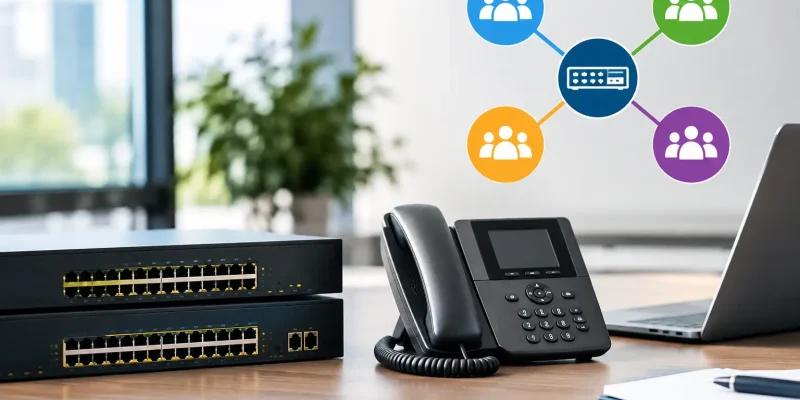
A phone system can be fully functional while call quality remains frustratingly inconsistent. The usual cause is not the handset or PBX. It is often a network where voice traffic competes with backups, video meetings, guest Wi-Fi, and everyday business applications. Knowing how to segment voice VLANs gives IT teams a practical way to protect call quality, reduce exposure, and make faults easier to isolate.
For organizations running cloud PBX, Microsoft Teams Phone with Direct Routing, Zoom Phone, or a contact center platform, voice VLANs are part of the communications foundation. They do not replace proper internet connectivity, Quality of Service (QoS), or Session Border Controller policies. They make those controls more effective by giving voice traffic its own defined path through the access network.
What Voice VLAN Segmentation Actually Does
A virtual LAN, or VLAN, separates devices into logical networks even when they use the same physical switches. A voice VLAN places IP phones and other approved voice endpoints in a dedicated network segment rather than leaving them on the same VLAN as laptops, printers, and general-purpose devices.
This separation matters for three reasons. First, it reduces broadcast and multicast noise reaching phones. Second, it gives switches and routers a clear basis for applying QoS and security policies. Third, it limits the opportunity for an unmanaged device on the corporate data network to interact with voice infrastructure.
A typical office deployment may use a data VLAN for employee devices, a voice VLAN for desk phones, a separate VLAN for Wi-Fi, and another for guest access. A contact center may need additional segmentation for workstations, voice gateways, management interfaces, recording services, and server workloads. The exact design depends on the organization, but the principle stays the same: separate traffic according to function, risk, and required performance.
Voice VLANs are not a guarantee of better calls by themselves. If the WAN is congested, DNS is unreliable, or the ISP connection has high jitter, segregation alone will not fix it. It does, however, prevent avoidable LAN-side contention and gives the IT team a far clearer operational model.
How to Segment Voice VLANs Step by Step
1. Map the current call path before changing switch ports
Start with an accurate picture of where calls travel. Identify IP phones, softphone users, PoE switches, wireless access points, SIP gateways, Session Border Controllers, PBX or cloud PBX services, and contact center components. Include branch offices and remote sites, not only headquarters.
Then document the existing subnets, switch uplinks, DHCP scopes, firewall zones, and internet or MPLS paths. In a hybrid environment, also identify traffic that must reach on-premises systems, Azure-hosted workloads, or regional telecom connectivity. This inventory prevents a common problem: moving endpoints into a new VLAN without accounting for services they must still reach.
2. Create a dedicated VLAN and IP subnet for voice
Assign a VLAN ID and an IP subnet specifically for voice endpoints. The numbering scheme should be predictable enough that operations teams can identify its purpose quickly. For example, a multi-site organization might allocate a distinct voice subnet per location rather than placing every office on one large shared voice network.
Smaller environments can often use one voice VLAN per site. Larger enterprises may segment further by floor, business unit, security boundary, or contact center function. More segmentation improves containment, but it also increases routing, DHCP, firewall, and troubleshooting overhead. The right approach is the simplest design that supports scale and security requirements.
Reserve address capacity for growth. Readdressing hundreds of phones later creates unnecessary disruption, particularly where devices are centrally managed or assigned to specific extensions.
3. Configure switch ports for phone and workstation traffic
Most desk phones include a small integrated switch. One cable connects the phone to the wall port, and a second cable connects the user’s computer through the phone. In this case, the switch port normally carries two networks: untagged data traffic for the computer and tagged voice traffic for the phone.
Configure the access port with the user data VLAN as the native or untagged VLAN and the voice VLAN as the dedicated voice VLAN. The exact command syntax differs across Cisco, Aruba, HPE, and other switching platforms, but the design intent does not. The phone should recognize the voice VLAN through LLDP-MED, CDP where applicable, or a supported provisioning method, then request an address from the voice DHCP scope.
Avoid relying on manually configured VLAN IDs on every handset unless there is no alternative. Manual settings are harder to maintain and create more room for deployment errors. Standards-based discovery is usually easier to support at scale.
4. Build DHCP, DNS, and provisioning for the new segment
Every voice VLAN needs a corresponding DHCP scope with the correct default gateway, DNS servers, lease duration, and provisioning options. Depending on the phone platform, DHCP may also provide the address of a provisioning server, call controller, or other boot parameters.
Confirm that phones in the voice subnet can resolve the required service records and reach approved cloud services. A phone that receives an IP address but cannot resolve its PBX hostname may appear healthy at the switch while failing registration. This is especially relevant for cloud PBX, Teams Direct Routing, and SIP-based deployments that depend on secure name resolution and certificate validation.
Use IP address reservations only where there is a defined operational reason, such as a gateway, SBC, or device with tightly controlled firewall rules. Dynamic addressing is generally easier for large phone populations.
5. Apply QoS end to end, not only at the access switch
Voice traffic is sensitive to latency, jitter, and packet loss. A voice VLAN makes classification simpler, but QoS must be applied across the full path: the phone, access switch, distribution layer, firewall, WAN edge, and internet or private circuit boundary.
Trust markings only from devices you control. A managed IP phone may mark RTP media as expedited forwarding, while a workstation connected behind it should not be able to claim the same priority without validation. Set clear policies for signaling and media, and make sure that low-priority bulk traffic cannot consume the queues reserved for real-time communications.
Do not over-prioritize everything. If every application is classified as critical, nothing receives meaningful protection during congestion. Measure actual concurrent call volumes, codec use, and contact center peaks so voice capacity is sized realistically.
6. Restrict access between voice, data, and management networks
Once voice endpoints have their own VLAN, control what they can reach. Phones typically need access to DHCP, DNS, NTP, provisioning services, call control, and approved voice gateways or cloud destinations. They usually do not need unrestricted access to employee devices, file servers, or management systems.
Use Layer 3 access control lists or firewall policies to permit only necessary flows. Separate switch and phone administration interfaces into a management VLAN, and require encrypted administrative access with strong credentials. Disable unused switch ports, limit MAC addresses where appropriate, and review whether network access control is suitable for the environment.
For UAE and GCC organizations, segmentation also supports a more disciplined compliance posture. It helps demonstrate that communications infrastructure is deliberately controlled, particularly when local PSTN connectivity, regulated telecom services, and cloud-hosted collaboration platforms are part of the design. Segmentation is one control within a broader security program, not a substitute for encryption, identity management, logging, and change control.
Validate the Design With Real Call Scenarios
Testing should go beyond checking whether a phone registers. Make internal and external calls, transfer calls, test voicemail, and place calls while the network is under typical business load. For contact centers, test queue calls, recordings, supervisor features, and peak agent activity.
Monitor latency, jitter, packet loss, interface errors, PoE utilization, DHCP failures, and SIP or platform registration events. A useful baseline includes calls from each office, calls to external numbers, calls between sites, and traffic through the chosen PSTN or Direct Routing path. If voice quality drops only during large file transfers or backup windows, the issue may be QoS or uplink capacity rather than VLAN configuration.
Also test failure behavior. What happens when a switch reboots, a DHCP server is unavailable, an ISP circuit fails, or traffic moves to a secondary SBC or cloud route? Communications architecture should be designed for the conditions that cause disruption, not only the conditions that make a demonstration look good.
Common Voice VLAN Mistakes to Avoid
The most frequent mistake is treating the voice VLAN as an isolated switch setting. A new VLAN without a working DHCP scope, routing policy, DNS path, and provisioning access simply leaves phones unable to register. Another is allowing unrestricted inter-VLAN traffic, which weakens the security benefit of segmentation.
Teams also run into trouble when QoS markings are trusted from every device, when voice and guest wireless share the same policy boundary, or when a branch office copies a configuration that does not match its local WAN capacity. In cloud communications projects, firewall rules and DNS behavior are often overlooked until users report intermittent registration or one-way audio.
Documenting the design is equally important. Record VLAN IDs, subnets, DHCP options, switch templates, QoS classes, firewall rules, and escalation procedures. When an office expands or a switch is replaced, clear documentation protects service continuity.
A well-planned voice VLAN is less about adding another network number and more about giving business communications the treatment they require. Build the segmentation around real call paths, enforce only the access each component needs, and validate performance under pressure. That approach keeps the network easier to operate while helping every customer conversation reach the right person without interruption.