
A cloud PBX project can stall over one small question: can VoIP support analog devices already installed across the business? In many cases, yes. Analog desk phones, fax machines, door intercoms, paging systems, and alarm communicators can remain in service while the organization moves its core calling environment to IP. The right approach depends on the device, its importance to operations, and the level of reliability it requires.
For organizations with multiple locations, the goal is rarely to preserve every legacy device indefinitely. It is to modernize communications without disrupting front-desk coverage, building access, safety processes, or customer service. That calls for an architecture decision, not just an adapter purchase.
Can VoIP Support Analog Devices in Practice?
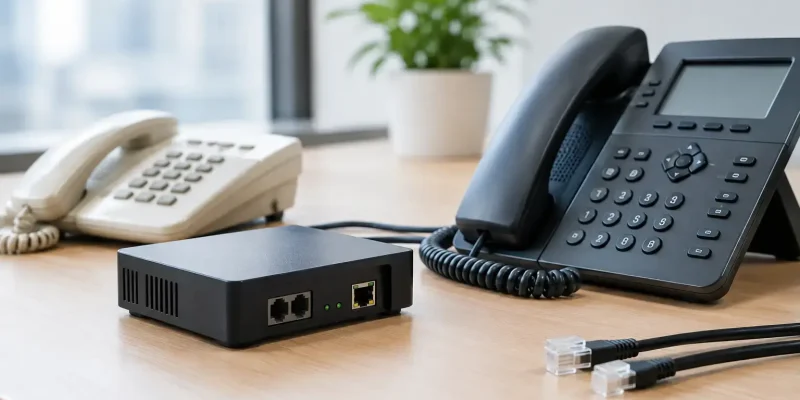
VoIP carries voice traffic over an IP network, while traditional analog endpoints use electrical signaling over copper pairs. A conversion layer is needed between them. This layer can be a small Analog Telephone Adapter, known as an ATA, an analog gateway, or an integrated telephony gateway connected to an IP PBX or cloud PBX.
The analog device plugs into an FXS port. The gateway converts its analog signaling into SIP traffic and sends that traffic to the PBX, Session Border Controller, or SIP trunk. To the cloud phone system, the device appears as an extension, a dedicated line, or a configured service endpoint.
This can be effective for standard voice calls. An analog lobby phone can call security, a reception handset can ring a hunt group, and an analog cordless phone can remain available in a warehouse where replacing handsets is not yet practical. The conversion does not make an old device feature-rich, but it can keep it connected to a modern calling environment.
The limits matter. Analog equipment was designed for a different network model. It will not gain native Teams calling controls, visual voicemail, call analytics, presence, or advanced contact center functions. If an endpoint is central to customer interactions, replacing it with an IP device is often the better long-term choice.
Choosing Between an ATA and an Analog Gateway
An ATA suits a limited requirement, such as one analog phone or a single fax machine. It is compact and cost-effective, but it is not usually the right foundation for a site with several legacy lines or operationally critical equipment. Configuration, monitoring, power protection, and support become harder when individual adapters are scattered across offices.
An analog gateway is designed for more structured deployments. It can provide multiple FXS ports, centralized configuration, SIP registration, call routing, failover rules, and network management. For a hotel, clinic, warehouse, school, or multi-floor office, this approach offers a clearer operational model.
The best choice is based on more than port count. Ask how many devices need to stay analog, whether calls must continue during an internet outage, where the devices are located, and who will support them. Also consider whether the existing equipment is approaching end of life. Spending heavily to retain an unreliable device can create a hidden operational cost.
For example, retaining two analog emergency phones through a managed gateway may be sensible. Retaining 40 aging analog desk phones simply because they are already installed may delay a needed modernization project.
Which Analog Devices Are Good Candidates?
Standard analog phones are usually the simplest devices to retain. Their signaling and voice requirements are predictable, and they generally work well through a correctly configured ATA or gateway.
Fax requires more care. Fax over an IP network can be affected by packet loss, jitter, codec selection, and network congestion. T.38 fax relay can improve reliability when supported end to end, but it is not a guarantee for every fax machine, PBX, carrier, or document type. If fax remains necessary for a regulated workflow, test real inbound and outbound scenarios before cutover. Where possible, a secure digital document workflow may be a more dependable long-term replacement.
Door entry phones, paging systems, elevator phones, and alarm panels need the closest review. These devices may rely on DTMF tones, line-voltage behavior, emergency dialing, or special signaling that does not translate cleanly through every adapter. A device that can place a call during a test is not automatically suitable for a life-safety or access-control role.
For these use cases, involve the device manufacturer, facilities team, security provider, and telecommunications integrator early. Confirm dialing behavior, caller identification, emergency routing, supervision requirements, backup power, and responsibility for testing. A separate cellular or purpose-built connection may be more appropriate for certain alarm and emergency applications.
Design the Network Around Continuity, Not Convenience
The analog conversion device is only one part of the solution. A VoIP deployment is as reliable as the network, internet connection, power design, and routing behind it.
Voice traffic should be segmented and prioritized with appropriate QoS policies. The gateway needs stable DNS, correct SIP settings, and secure connectivity to the cloud PBX or SBC. Firewall rules should be specific rather than broadly opened, and SIP traffic should be protected using encryption where the platform supports it.
Power deserves equal attention. Traditional analog lines often provided line power from the carrier network. An ATA, analog gateway, router, switch, and internet circuit do not. If the building loses power, an analog phone connected to a gateway will only continue working if the supporting equipment has battery backup or generator coverage.
Resilience can be designed in several ways: dual WAN links, automatic call forwarding to mobile numbers, backup SIP routes, high-availability SBCs, and local survivability for critical sites. The right mix depends on the cost of downtime. A reception phone can tolerate a short interruption differently from a security desk, customer contact center, or emergency communications point.
Local Telecom and Compliance Considerations
For UAE organizations, analog device integration should be planned alongside PSTN connectivity and regulatory requirements. A cloud PBX may be hosted in-region or connected through approved local telecom services, but the calling design must align with TDRA requirements and the selected carrier model.
This is particularly relevant when a business uses Microsoft Teams Direct Routing, Zoom Phone BYOC, or a hosted PBX alongside existing analog lines. The question is not only whether the endpoint can register through a gateway. It is whether the full call path, emergency handling, number presentation, security controls, and support model are appropriate for the organization.
A local integrator can coordinate the infrastructure layers that are often treated separately: carrier connectivity, Session Border Controllers, gateway configuration, network readiness, and post-deployment support. Cloud Move applies this approach to help organizations modernize without creating a fragile mix of disconnected services.
A Practical Migration Plan for Legacy Analog Endpoints
Start with an inventory, but make it operational rather than administrative. Record every analog device, its physical location, number, purpose, owner, and impact if it fails. Identify whether it handles routine calling, customer access, facilities operations, security, or an emergency function.
Next, group devices into three decisions: retain through an ATA or gateway, replace with an IP-native alternative, or move to a dedicated connectivity method. This avoids treating every analog port as equal. It also gives finance and operations teams a clear view of short-term costs and long-term risk.
Before cutover, test the exact conditions that matter. Place inbound and outbound calls, transfer calls, validate DTMF input, test fax transmission if applicable, check caller ID, and confirm behavior during WAN failure and power loss. For access, alarm, elevator, or emergency systems, document the test results and obtain sign-off from the responsible provider or department.
Finally, monitor the environment after go-live. Review call failures, registration status, packet loss, and gateway alarms. A communications platform should be supported as an always-on service, not treated as a one-time installation.
Common Questions About VoIP and Analog Devices
Can an analog phone work with a cloud PBX?
Yes. An ATA or analog gateway can register the phone as an extension or route it through a SIP service. It will support basic calling, but advanced cloud PBX features may be limited by the phone itself.
Will my fax machine work over VoIP?
It may work, especially with T.38 support and a stable network, but it should be tested thoroughly. Fax is more sensitive to IP network conditions than voice calls.
Do analog devices work during an internet outage?
Not by default. If the gateway depends on the internet to reach the PBX or SIP trunk, calls will fail when that connection is unavailable. Backup connectivity, failover routing, or local survivability must be designed in.
Keeping selected analog devices is a practical bridge to modern communications when it is done with clear testing, resilient network design, and an honest view of each device’s role. The most useful question is not whether a legacy endpoint can be connected, but whether it will remain dependable when the business needs it most.